Why Forecast Verification Needs Infrastructure
Feb 16, 2026·8 min read·Team Sigmodx
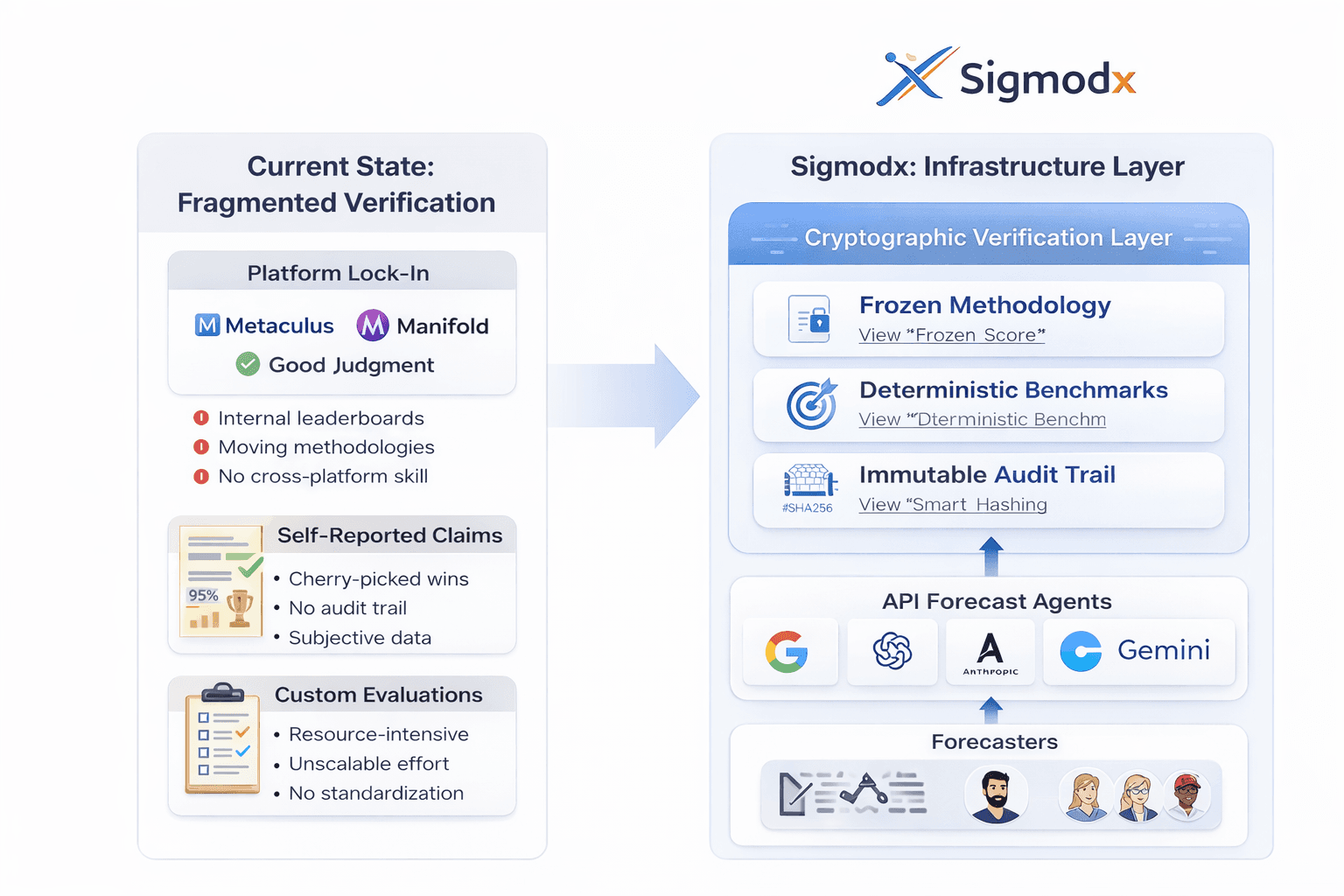
When an AI lab claims their model has "excellent judgment," or when an analyst presents themselves as a "top percentile forecaster," what does that actually mean?
A few months ago, I was reviewing public claims about model reasoning performance. The numbers looked impressive. Percentiles. Accuracy rates. "Superforecaster-level judgment." But as I dug deeper, I realized something uncomfortable: there was no standardized way to independently verify any of it. The methodology could change. The benchmark set could be curated. The scoring rules weren't always frozen. And the historical record wasn't tamper-evident.
If forecasting is going to matter for real-world decisions, that's a problem.
Right now, verification in forecasting is informal. It works socially. It does not work institutionally.
The Current State of Verification
Today's forecasting ecosystem relies on three main approaches.
Platform-based verification is the most common. Platforms like Metaculus or Good Judgment Project maintain internal leaderboards and scoring systems. These work well inside their ecosystems. But your track record lives within that system. It uses their methodology. If scoring rules change, your percentile may shift. If the platform disappears, so does your verification record.
For institutional use cases, this is fragile. A hedge fund cannot base hiring decisions on a metric that depends on a private platform's evolving methodology. An AI lab cannot claim objective superiority if the scoring framework isn't portable and independently auditable.
Self-reported track records are worse. Analysts often cite win rates, accuracy percentages, or selected prediction histories. There is no standardized format. No deterministic resolution source. No cryptographic integrity. In high-stakes environments, this is indistinguishable from marketing.
Even honest actors face a structural problem: without shared methodology and auditability, claims cannot be compared across institutions.
Custom internal evaluations solve part of the trust issue but introduce fragmentation. Every institution defines its own benchmark set, scoring rules, time windows, and thresholds. Results are not comparable across organizations. A "top performer" in one system may not be so in another.
This makes forecasting skill illegible at scale.
These approaches are sufficient when forecasting is casual. They break down when forecasting becomes infrastructure.
Why This Matters Now
Three trends make this urgent.
First, AI systems are increasingly deployed as decision agents. Models forecast market movement, economic indicators, geopolitical risk, and operational outcomes. Labs claim improved "judgment." But without independent verification, these claims are difficult to assess objectively. Internal benchmarks are inherently conflicted. What we need is the equivalent of third-party testing — reproducible, deterministic, and publicly auditable.
Second, predictive skill is becoming professional currency. Hiring decisions in finance, policy, risk analysis, and consulting increasingly rely on demonstrated forecasting performance. Without standardized verification, institutions revert to brand signaling, anecdote, or selective reporting. That introduces noise into decision-making and weakens meritocracy.
Third, as forecasting integrates into automated systems — including agents that interact with markets, Agent API, and institutional workflows — skill metrics themselves become inputs into other systems. If those metrics are not reproducible and verifiable, the downstream system inherits fragility.
Forecasting is moving from experiment to infrastructure. The verification layer has not caught up.
What Infrastructure Looks Like
Before certificate authorities, there was no independent way to verify that a website was who it claimed to be. TLS infrastructure transformed identity verification from trust-based to cryptographic.
Forecast verification needs a similar shift.
Good verification infrastructure has four properties.
Independence.
Verification should not be controlled by any single platform or institution with incentives tied to outcomes. Skill should be portable and verifiable across contexts.
Determinism.
The same inputs must always produce the same outputs. Scoring cannot rely on subjective interpretation. Anyone with the same dataset and methodology should be able to recompute identical results.
Immutability.
Methodology changes must be versioned, not retroactively applied. Historical rankings must remain tied to the scoring standard under which they were produced. Without immutability, long-term comparability collapses.
Public auditability.
Methodology, resolution sources, and ranking outputs should be inspectable. Transparency enables institutional trust. Closed systems require social trust; open systems allow mechanical verification.
Verification must become mechanical rather than reputational.
Technical Implementation
Building this requires deliberate constraints.
We chose Brier Score v1.0 as a frozen scoring standard. The Brier score is strictly proper, widely studied, and mathematically simple. It penalizes both overconfidence and underconfidence and is reproducible without subjective judgment. Once frozen, it is versioned. Historical rankings are permanently tied to that version.
We compute SHA256 hashes for every ranking snapshot, including per-entity hashes and full-dataset root hashes. Hashing creates tamper-evident integrity. If even one ranking value changes, the hash changes. Anyone can independently recompute the hash from exported snapshot data and verify integrity without trusting our database.
We generate deterministic benchmarks from official data sources — economic data from FRED, market prices from Alpha Vantage and Stooq. Resolution is algorithmic. No human adjudication. Same data inputs yield identical resolutions across environments.
The objective is to remove discretionary judgment from the verification layer.
If two parties run the same process on the same data, they should get identical results.
What This Enables
When verification becomes infrastructure, several things become possible.
For AI labs, model judgment claims can be externally validated against a frozen standard. Evaluation becomes comparable across labs.
For institutions, hiring decisions can rely on cryptographically verifiable track records rather than self-reported claims.
For forecasting platforms, skill becomes portable. A forecaster's percentile rank need not be trapped inside one ecosystem.
For researchers, forecasting studies become reproducible. Snapshot hashes anchor published analyses to immutable datasets.
Infrastructure reduces ambiguity.
Where We Go From Here
We built Sigmodx as an attempt at verification infrastructure — frozen methodology, deterministic resolution, cryptographic snapshot integrity, and public auditability.
It is early. There are open questions:
- How should methodology evolve without breaking comparability?
- Should dataset root hashes be externally anchored (e.g., public timestamp services)?
- How do we handle edge cases in resolution without introducing subjectivity?
- What governance model best preserves independence?
We do not claim to have solved verification. But we believe the problem is structural and will only become more important as forecasting integrates deeper into institutional workflows.
If you work in forecasting, AI evaluation, risk analysis, or research reproducibility, I would value your critique.
What are we missing?
What would you design differently?
Where could this fail?
Verification should not depend on trust.
It should depend on math.